|
Shoulder Labrum TearsShoulder labrum tears can be a difficult condition to manage, and diagnosis has become more and more accurate for a situation that, many years ago, went undiagnosed.
Shoulder labrum tears can often go unnoticed until they become severe and cause pain and a "popping sensation". These tears are often associated with rotator cuff tears because the biceps tendon can sublux (partially dislocate) or completely dislocate from its "groove". Our Shoulder Joint Anatomy page will show what the glenoid labrum looks like, but we'll briefly review it here. The shoulder labrum is a ring of fibrous cartilage that acts somewhat as a joint stabilizer by functionally "deepening" the joint. The shoulder joint is the most unstable joint in the body and the presence of the labrum serves to reduce that instability. There are two biceps tendons; the long and short, which correlate to the long and short heads of the biceps muscle in the upper arm. The long head biceps tendon inserts into the top, or 12 o'clock position on the glenoid (socket). It does so in a flared fashion extending frontward and also around the backside of the glenoid rim. The attachment point is called the "biceps anchor".
TYPE I The Type I SLAP tears is evidenced by a fraying of the inner edge of the labrum as it sits over the top of the socket. This is the most common type of SLAP tear encountered. Occasionally there can be some level of separation of the labrum from the bony edge of the glenoid.
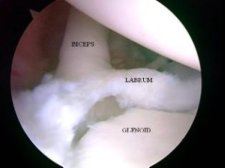
TYPE II This type of tear/detachment (seen at right) occurs when the biceps anchor, literally, completely separates from the superior glenoid rim and extends in both directiosn from the base of the biceps tendon. Type II "lesions" begin to involve the posterior and the more anterior portions of the glenoid labrum. This, in turn, can create an unstable, painful situation with various shoulder movements.
Go to Shoulder Pain Page
|
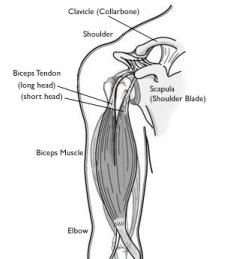 When these tears occur, they do so in a variety of degree of severity, of "types". They are also know as "SLAP" tears, which stands for Superior Labrum Anterior to Posterior.
