Degenerative Disc Disease
Degenerative disc disease typically refers to the breakdown of the material that comprises the discs of the spinal column. This degenerative process can occur at any level within the spinal column and is, unfortunately, part of the natural aging process.
Briefly, the inter-vertebral discs (“discs”) are the fleshy structures that occupy the spaces between the spinal vertebrae (bony elements of the spine). They are primarily composed of two main types of cartilage; the NUCLEUS PULPOSUS, which is the soft (almost-crab meat consistency) central portion of the disc, and the ANNULUS, which is the tough fibrous (fibro-cartilage) outer “ring” that supports the vertebrae and contains the nucleus pulposus.
In cases of degenerative disc disease, and for any number of reasons (trauma, surgery, disease, infection, obesity and aging), the components of the disc begin to dehydrate (lose their water content) and become increasingly brittle. The annulus begins to crack and bulge, like an under-inflated tire, and the nucleus often times literally disintegrates from being reabsorbed into the body.
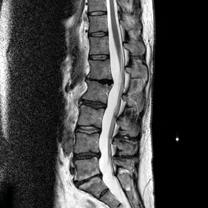
Notice in the above MRI picture the changes in the "color" of the discs. The lighter the image of the disc, the more water content present and the healthier the disc.
Note the areas of narrowing and bulging from the degeneration process. If you look closely at the vertebrae, you can also see spur formation and how it "encroaches" upon the spinal canal.
As the process of degenerative disc disease worsens, and as the disc material continues to break down and disappear, several things begin to happen to the bony structures of the spinal column.
The spaces between the vertebrae begin to narrow and collapse due to the loss of support from the outer annulus of the disc. This, in turn causes increased pressure and load stress upon the small joints that connect the vertebrae, called FACET JOINTS. Like any other joint, the smooth cartilage surfaces begin to break down and deteriorate under the stress. Ultimately these facet joints become arthritic and somewhat unstable.
Over time, the vertebrae develop bone spurs around their outer circumference, mostly due to the increased motion between them from disc deterioration. Consequently, these spurs can become pressure points on the spinal sac and/or nerves that exit through small openings, called FORAMEN, en route to their various destinations. As you would imagine, similar degeneration eventually begins to take place on adjacent vertebral segments of the spine causing a “cascade” of events up and down the spinal column.
In mild forms of this condition, treatment options can include pain medication, aquatic therapy, bracing, cortisone injections or anti-inflammatory drugs. In the more severe cases of degenerative disc disease, surgery may be required to decompress, or relieve pressure, from bulging disc material or bone spurs on spinal nerves to relieve chronic pain. If instability of any of the vertebral segments is severe enough, some type of fusion procedure may also be needed.
Leave Degenerative Disc Disease; Return to Home Page
Return to: Low Back Pain
