Home
About Us
Contact Us
Find a Doctor
Arthritis Osteoarthritis
Arthritis Types
Rheumatoid Arthritis
Psoriasis
Fractures Fractures
Fracture Types
Adult Fractures
Kids' Fractures
Salter-Harris Fracture
Salter Type I Fx
Salter Type II Fx
Salter Type III Fx
Salter Type IV Fx
Hand & Wrist Wrist Fractures
Scaphoid Fractures
Scaphoid Fx Diag.
Scaphoid Fx. Treat.
Knee Knee Joint Pain
Knee Sprain
Knee Cartilage Tears
Knee Arthroscopy
Knee ACL Surgery
Foot & Ankle Ankle Pain
AnkleFracture
Treating Ankle Sprains
Ankle Braces
Heel Pain
Heel Pain Treatment
Hip Hip Fracture
Hip Pain
Back & Neck Low Back Pain
Spinal Stenosis
Shoulder Shoulder Pain
Shoulder Anatomy
Shldr Impingement
Rotator Cuff Tear
Cuff Tear Symptoms
Shldr Arthroscopy
Shoulder labral tear
Joint Replacement Joint Replacement
Shoulder Replacement
Anesthesia Anesthesia Types
Epidural Anesthesia
Fem. Nerve Block
Interscalene Block
Suprascapular Block
Medications & Treatments Joint Pain Remedies
NSAIDs
Alternative Pain Rx
Pt. Advocacy Patient Advocate
Web Friends

Salter-Harris Fractures


Salter-Harris fractures belong to a specific classification of pediatric fractures which can occur in children during their bone growth years. These injuries are unique because the vast majority involve the areas of bones where the actual growth occurs; the growth plates.

The entire Salter-Harris fracture classification system is built around the mechanism of injury, location of the fracture, as well as the extent of involvement of the growth plate.

Growth plates in children are literally the “manufacturing plants, of new bone. As new layers of bone are produced, they are laid upon the previous layers, thus accounting for the increase in bone length during the growing years.

One unique feature about growth plates is that the new bone material being produced and manufactured is still young and not matured.

There is little to no calcified, or hardened, bone located in the active areas of the growth plate, and consequently do not reflect x-ray beam penetration.

That is why, on x-ray examination, growth plates will look like “spaces”, or even fracture lines when compared to the surrounding, hardened calcified bone.

It is not unheard of that growth plates can be mistaken for fracture lines in children who are at the age where growth plates begin to close, or “fuse”.

Another, less positive, attribute of growth plates is their vulnerability to injury. The portion of a bone where a growth plate is located is considered to be the weakest area of it.

Injuries to these plates or “physes” can occur long before breakage of the more mature, hard bone occurs, as is seen in the shafts of long bones.

The Salter-Harris Classification System:

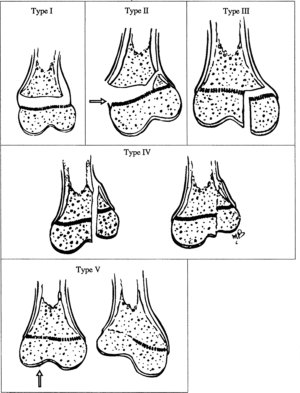
For many years there were five (5) major classifications of pediatric fractures in the S/H system. A sixth (6th) classification was ultimately added to the list. You’ll see in the picture below a pictorial representation of what a fracture would look like at different stages of severity/growth plate involvement.


Once the classification system is understood, merely describing an injury as a “Salter-Harris type I” or “type IV” immediately gives reference to the nature of the fracture and how it involves the corresponding growth plate.

Let's look at a brief description of each of the fracture types.

For Type I fractures, Click Here

For Type II fractures, Click Here

For Type III fractures, Click Here

For Type IV fractures, Click Here

For Type V fractures, Click Here

Leave Salter-Harris Fractures, Go to Fractures

Go to Pediatric Fractures

Go to Home Page


TopMedical - Lowest Prices Guaranteed


Visit OTCOnly.com!


Get Relief from Tension and Sinus Headaches with Headache Pain Management from Forces of Nature - FDA Registered!