|
Salter-Harris III FractureA Salter-Harris III fracture, similar to its type II counterpart, also starts through the growth plate, but turns and exits through the end of the bone, and into the adjacent joint. The resultant joint surface involvement can make for tricky treatment. Any disruption of the joint surface poses a threat of increased joint damage, with the prospect of developing post-traumatic arthritis more possible. These injuries can be concerning because the joint cartilage is disrupted by the fracture. Proper positioning is essential after a type III growth plate fracture. These injuries also tend to affect older children.
The fracture here is of the ankle,and involves the distal end of the tibia, or shinbone. Notice the vertical fracture line as it originates from the growth plate at the upper end, and migrates through the end of the bone and into the joint proper. Notice, too, that there is a slight amount of separation, also called "displacement" of the fragment at the joint level. In instances where the amount of separation, or displacement, is unacceptable, it may become necessary to "close the gap" surgically by the use of one or more screws inserted parallel, and distal (closer to the joint) to the growth plate in order to avoid any further damage or injury to the growth plate.
Leave Salter-Harris III Fracture; Go to Salter-Harris Fractures page
|
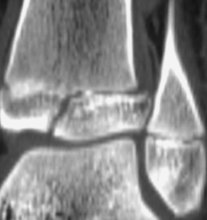 The picture to the left shows how the Salter-Harris III fracture would show up on a CT scan.

"We hope you enjoy your journey through Bone and Joint Pain.com"